keskiviikko 18. joulukuuta 2013

Armored reiters - work in progress


Some Acies Edizioni  Pappenheim- cavalry waiting to be drafted to a foreign regiment in Polish service. These guys will probably serve as two banners, combined  into one  squadron on the field.

For some reason they all have white horses and similar, blued armor.

Coats vary between off white, red and tan. Horse gear swords and helmets expect color


maanantai 2. joulukuuta 2013

Units that have already seen action

None of these units have gotten the varnish or flocking.
Some of them would require more than just that.

The pancerni are most advanced in painting - Legio Heroica production sans lances so far. Lacking some higlighting, maybe  and static grass or other basing texture. The hardest hitting unit in my skirmish force - so far deployed in squadron of 3+2 bases.
 Cossacks - the main troop of a Polish commander - Legio Heroica Polish light cavalry. Some touchup and work on bases required. The hitting power of their charge has been surprising. Elite cavalry rule, companion special rule and impact bonus from long charge really make these guys lethal.
Legio Heroica Gonullu. ie Ottoman cavalry from the Balkans. I have fielded them as Wallachians. Decent scouts - and have even won a melee fight with artillery battery. Without the lances that they would have as Ottoman troops.
The Polish commander - Legio Heroica General with a standard bearer. So far fielded as a colonel in skirmish battles.
Troop of Acies Edizioni Croats. I have fielded them as Polish cossack cavalry with no qualms. They may make an appearance as Croats at some point if I get an Imperial force onto the field. Standard bearer - at this point without his flag, from Legio Heroica gonullu range.
Last a company of Dragoons - From by Fire and Sword Swedish skirmish set, with colors of Polish Crown Dragoons - although in western costume, not the typically Polish.

Together these guys form a pretty strong skirmish force, but they apart from the dragoons and together with the other forces I have underway these guys help to flesh out regiments for the divisional level of play. Especially cossacks are required since Polish division needs to have minimum of two Polish cavalry regiments. There is some leeway whether they are basic, light or elite, Lithuanian or Polish, but cossack cavalry is required in all. They can have as support dragoons, infantry or western type cavalry regiments and divisional companies in relation to the amount of  regiments (max five).

Getting to the divisional level will probably take time, so there is strong temptation to just push on in gettin more units into recognizable colors at the same time and leave final basing and finishing to  one big final effort. However, since I will probably need to look at these fellows of skirmish play for longish period I try to get them into shape that does not hurt my eyes before the New Year.


Some more works in progress

I have been painting some polish cossacks and volunteers to complement existing troops.
The two cossack banners are almost done - just waiting for a shading of wash, lacquer and some grass and details on the base. Blue reins give the unit surprisingly blue overall look. For some reason I seem unable to focus on just compelting the guys once they are almost done. So...
I have at the same time dabbled with volunteers - their horses still need painting, as well as much of their clothing. These were supposed to be "the blue troops"  but may get more tan or yellow topcoats to lighten the overall impression.
And even more fuzzy ride the German type reiters. These guys are going to play role of German mercenary reiters, possibly Danish and Imperial troops as well. Red will be their main identification color - in sashes and feathers, with white, red and tan  dominating jackets and coatcolors. At the moment the most finished guys, in the front, are a tad too uniform for historical accuracy.
 I might give these guys mainly white and light grey horses in contrast to Poles riding grey and brown horses.

And  as an aside - I need to actually learn how to get decent pics - pic quality here is abysmal.


sunnuntai 24. marraskuuta 2013

By Sword and Fire II

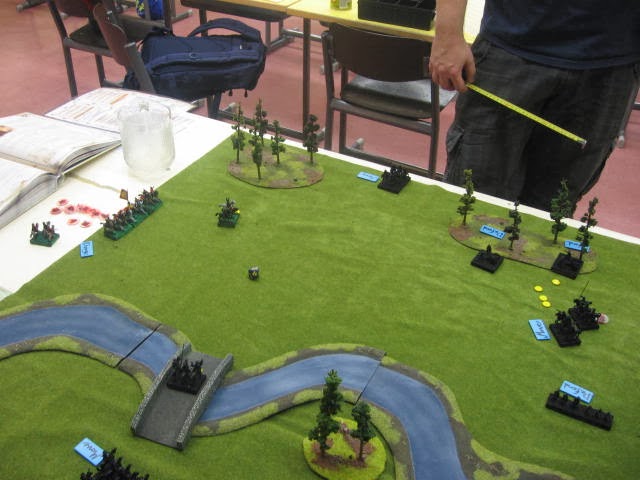
Again colonel Opalinski and his troops were battling the Swedes for control of a bridge.
This time the Swedish commander had less troops at his disposal and Opalinski had gotten an extra banner of Tatars to supplement his previous forces.

Hence the Swedish player rolled for scenario - with difference in points being so small that he could only choose holding the bridge. This was something he was not too happy to do since this time his troops consisted of squadron of armored veteran reiters with four bases, a three base company of national reiters, another four base squadron of arquebus reiters and a large company of dragoons. A force not really suitable or defensive action.

With superior scouting I could leave one unit as flanking force - choosing this time to use my dragoons for that task. 

He deployed national reiter squadron on bridgehead, with armoured reiters back on the other side of bridge - ready to pounce on anyone passing it, Dragoons dismounted on the side of the bridge and arquebuisers on the side of the ford.

I had my cossacks in one 6 base squadron ready to carge the bridgehead, followed by pancerni in one squadron, with tatars, wallachians and volunteers guarding the right flank towards the ford.

Both side rolled for an additional effect. He got to give my colonel a bad day - leaving annoyed Opalinski with just three command points. I got panic and chose to give this affliction to his squadron of armoured reiters.

On first round Poles got initiative. Remarkably the disordered reiters remained so milling aimlessly about. The cossacks reached the Viborg cavalry troopers on bridgehead - being closer than my opponent had anticipated, but only with three bases making contact- being further than I had thought.
The charge got Viborgers fleeing and after pursuit blasting though already disordered armoured reiters
- who broke and fled also.

The flankers approached to range of peppering dragoons with long range fire - that had no effect. The dragoons gave pursuing cossacks a salvo that gave some casualties, but resulted in no panic.

With the armored reiters beyond Swedish colonels command range at the start of round 2 the game was practically over. Dragoons put up a decent defence, but were worn out by sheer numbers, and on my left flank the strong squadron of mounted arquebusiers got slowly whittled away by tatar and wallachian fire with Danzig volunteers keeping them bogged down.

Battle was over by round four with strategic victory to Opalinski. ( The fleeing reiters actually saved so big chunk of Swedish forces that it was not really a historic one.)
Record between Oxenstierna and Opalinski is now 1-1.

This time thee disorder to reiters was crucial to the result - but for it to end in such major disaster Swede had to fail his rally, lose the battle badly, lose his morale save and again when fleeing through the reiters lose the morale save again.

The game went smoothly - playing time this time about two and a half hours which we felt was pretty OK. We did not experience bigger troubles with the mechanics this time. We had to have a discussion what we felt plausible for cavalry leaving the bridge and charging the Swedish dragoons. 

tiistai 19. marraskuuta 2013

By Fire and Sword - First Try

The game was setup with main motivation of getting hang of the rules.
I had a Polish skirmish force of 11 Force points against 12 points Swedish detachment of my opponent.
I had colonel upgraded to 4 command points, with assisting Rotamaster. Two banners of pancerni, two banners of cossacks, a company of dragoons, one banner of wallachians and one large banner of volunteers. My opponent brought similar command, 4 banners of reiters, a banner of arquebus armed reiters, 2 companies of dragoons, 2 companies of musqueteers and 2 regimental guns.

With my force weaker I got to roll for the scenario. Rolling two times ambush and once bridge battle we got the bridge battle, since the difference in strength points did not allow for me to take the ambush.

For additional effects I got delay for the enemy, stranding half of his dragoons from the deployment and both got unexpected reinforcements allowing us to attempt get destroyed units back into the game. My huge advantage in recon allowed me to set one unit aside for later appearance as flanking unit – to which rople I set one banner of cossacks.

I deployed first concentrating my force on the side of the ford, with idea of making a wide sweep with the heavy hitting pancernicossacks set up as one strong squadron and with their flanks covered by wallachians and volunteers. This proved to be an tactical error since holding the bridge was the main objective of the scenario

My right flank: wallachians, dragoons Pancerni and the volunteers from Danzig.


My opponent deployed his reiters in one squadron towards the bridge, with musqueteers, arquebusiers and dragoons on the side of the ford and guns in edge of forest with field of fire to bith bridge and ford.

The proud cossackbanner ready to charge the puny Swedes.
First round saw my gallant cossacks on the bridgehead charging the enemy reiter squadron twice its size and receiving a countercharge. Results were unpleasant for the cossacks who first received the reiters pistol fire while charging and even though they gave at least as much casualties they got were overwhelmed by the Swedish iron discipline and sheer numbers of the reiters – resulting in withdrawal and new lost combat after pursuit. 


On the side of the ford my pancerni, volunteers and wallachians moved nicely forward, with dragoons taking defensive positions at the side of the ford.

The force on the ford advancing in good order.


The enemy as said charged at the side of the bridge. His dragoons, musqueteers and arquebusiers tried to block the ford and moved forward. His cannons opede fire against the Danzig volunteers with no visible results.


Round two saw my cossacks fleeing from pursuing Swedish reiters and my right advancing in good order although slowly - even though the Poles could swim with their horse they still advanced only at half pace.

At this stage my opponent dismounted his dragoons and prepared his musqueteers for defence. On round two - designated time to start calling the flankers in the guys refused. On round three I got an 0 meaning they would not come this round - or round four either...
Poles in the river, Swedes loading their firearms on the right.
 The game proceeded with my volunteers taking on the Swedish banner of mounted aquebusiers on countercharge - and much to our mutual surprise actually beating them back by sheer weight of numbers. We both kind of expected them to just  collapse under disciplined attack of Swedish Reiters. The Pancerni got the musqueteers and with some abysmal dice rolling on Swedish salvo threw them back in sweeping movement.  (No damage - maybe one hit with eight dice!)

With the wallachians rounding the flank Polish attack could turn left towards, the bridge on rounds four to six.

 My wallachians and pancerni turned towards the Swedish guns and charged. The Swdish commander was pulling his battered arquebusiers and his big squadron of reiters towards the bridge for the final stand. At this point my gallant volunteers charged the Swedish dragoons on the flank - making zero damage and collapsing in shock on witnessing such tenacity.

Guns at the edge of the top forest, volunteers fleeing in the middle. Pancerni and wallachians turning towards the guns


On round five my flanking cossacks finally arrived and charged a company of enemy dragoons that at last had arrived to the field - the delayed unit remember? Succesful charge left the cossack loitering at the edge of the map with no orders - outside the command range of my second in command. The pancerni charged the foremost cannons, got hit first on the flank by those pesky dragoons left there by volunteers and than by canister shot and decided to  call it a day. (without even losing a base...)

On round six my wallachians killed the enemy gun, enemy shot some errant shots towards various targets, but no real changes happened. Swedes took heavy losses, Poles acceptable. With the difference of one in strength points and the objective firmly in the Swedish hands it was a tactical victory to the Swede.


Both sides made errors in deployment - the Swedish player complained leaving his guns too far back and wasting his shots into inefficient long range fire. I did not utilize the bridge enough but got mired into crossing the river by ford and swimming - costing me time before getting into fighting contact. And leaving the actual objective badly undefended.

But nice first try. Lots of stuff was played a bit wrongly, but general pace of game was better than I feared and the feel was pretty intuitive. Finding needed rules in the middle of the game on the other hand definitively was not.


tiistai 12. marraskuuta 2013

WIP Pancerni

Ei peliä pitkään aikaan. Muut harrastukset ovat pitäneet kiireisenä.
Lisäksi on työllistänyt varustautuminen uudella armeijalla, vaikka Italian sotienkin projekti on vielä kesken... Ja By Fire and Sword sääntöjärjestelmään tutustuminen.
Työn alla nyt myös 1600-luvun puolen välin Puola ja sopivasti sen naapureita.

Kiireellisenä työn alla pieni joukko Legio Heroican Pancerni-ratsuväkeä puolalaisen skirmishjoukon rungoksi.

And first comment on English. This blog is for my own documentation of my wargaming and starting of miniature painting. We started with Pike and Shotte and Italian armies with a friend, but now focus is shifting with By Fire and Sword towards Poland. WIP some Pancerni by Legio Heroica.
 

tiistai 15. lokakuuta 2013

Pari peliä takana

Takana viime päivityksen jälkeen 2 peliä pike and shotteajoista ei kuitenkaan kuvia.

Kokeiltiin asetelmaa, jossa hyökkääjällä oli laskennallista ylivoimaa pisteissä mitaten suunnilleen tuplaten. Paavilliset joukot työn sivät tappion kärsineitä venetsialaisia edelleen edellään.

Opetuksia: talot ja muurit antavat puolustajalle todella tuntuvan edun. Ei kuitenkaan riittävää kompensoimaan näin vahvaa ylivoimaa. Avoimessa muodossa häröilevät stradiotit voivat häiritä moista staattista puolustuslinjaa aika lailla ja suojata perässä etenevää iskuporrasta tykistöltä melko tehokkaasti. Ja liikenneruuhkat takkuavat hyökkäyksen etenemistä pahimmillaan todella ärsyttävästi. Epäonnistuneet komentoheitot etummaisena kulkeneelta kevyeltä ratsuväeltä jättivät sen pahasti jalkaväen jalkoihin.

Sama ongelma oli jälkimmäisessä pelissä, jossa kumpikin pelaajista organisoi armeijansa kahteen suureen battagliaan. Hyökkäävän keisarillisen komennolla 9 liikkuneet landsknehdit marssivat kevyen ratsuväkisiiven yli sen jäädessä tupeksimaan. Steady-sääntö, jota keisarillinen jalkaväki pääsi Frundsbergin ansiosta hyödyntämään osoittautui äärimmäisen hyödylliseksi - venetsialaisen raskas ratsuväki raateli kyllä keisarilliset hilparit romahtamisen partaalle, mutta steadyn ansiosta eivät saaneet heitettyä lohkoa edestään. Ja seuraavalla kierroksella saivat kylkeensä knehtipiikkien rynnäkön...
Muuten peliä luonnehtii lähinnä liikkumisen tahmeus ja heittoaseratsuväen jatkuva häirintä. Ratkaisevan tuloksen arvioni mukaan tuotti venetsialaisen raskas tykistö, joka kahdella patterilla vähitellen moukaroi knehtejä murtumarajan yli ja tuotti tasaisesti tappioita keisarilliselle ratsuväelle.